Viminacium, a Roman city and legionary camp near Kostolac, is one of the day trips we most warmly recommend to our guests: it lies about 40–45 kilometers from Silver Lake (Srebrno jezero), the tour takes an hour and a half to two hours, and it feels like stepping straight into antiquity. In this guide you'll learn why Viminacium is called the "Pompeii of the Balkans", what you'll see on the guided tour — from the amphitheater and Roman baths to the imperial mausoleum and frescoed tombs — what tickets cost in 2026, when the park is open, and which route to take from the lake.
The Pompeii of the Balkans: Serbia's most important Roman city
Before the Romans, this stretch of the Danube was home to the Celtic tribe of the Scordisci; from the mid-1st century AD — according to the sources, from the year 52 — the legion VII Claudia fortified its camp here. Around that camp, one of the two largest fortifications in the province, grew a city that would become the capital of the Roman province of Upper Moesia: the administrative, military, trading and industrial center of the entire region. Viminacium held the status of a municipium, and in the early 3rd century it became a colonia with the right to mint its own coins; at its peak it is estimated to have had around 40,000 inhabitants, making it one of the largest cities in the Balkans of its day.
The city was sacked by the Huns in 441, rebuilt by Emperor Justinian in the 6th century, and taken by the Avars in 584. It is mentioned by Ptolemy, Priscus, Procopius and the famous Roman road map, the Tabula Peutingeriana. The first scientific excavations were launched by Mihailo Valtrović back in 1882 — with just twelve prisoners as his entire workforce — and, curiously, Queen Draga donated 100 gold coins in 1902/03 to keep the research going, the first donation ever made for the study of ancient cities in Serbia. The Institute of Archaeology has been conducting systematic excavations since 1973.
What makes Viminacium unique is that no modern town ever grew over it — unlike the Roman remains beneath Belgrade, Niš or Sremska Mitrovica, the entire ancient city of more than 450 hectares lies here under farmland and can be explored without obstacles. That is why journalists and travel writers call it the "Pompeii of the Balkans". More than 13,500 graves have been uncovered in its cemeteries so far, and the Serbian section of the Danube Limes, to which Viminacium belongs, is on the UNESCO Tentative List.
What to see at Viminacium: the guided tour
The Viminacium Archaeological Park can only be visited with one of the park's expert guides, and the guiding is included in the ticket price. Tours leave every hour, on the hour, and last 1.5–2 hours on average; they run in Serbian and English, while other languages must be requested at least 10 days in advance. The site is vast, so visitors drive between some of the stops in their own car, following the guide, while in summer a tourist train also shuttles between the mausoleum and the baths. At the time of writing, the guided tour covers the imperial mausoleum, the Roman baths, the amphitheater, the Limes Park and the central peristyle of the Domus science center.
The imperial mausoleum and the frescoed tombs
The mausoleum, set on a square base of 20 by 20 meters with a central structure of green schist, holds one of the most intriguing finds in Serbian archaeology: the deceased was cremated on the spot, in a rare ritual known as bustum, and some twenty gold objects were found with him, including a gilded fibula. Researchers hypothesize that this is the burial place of the Roman emperor Hostilian, who died in 251 AD — officially, while DNA analyses are still under way, they cautiously speak only of "a person of exceptionally high rank". Nearby are the underground tombs with frescoes, superb examples of late antique painting that include a monogram of Christ. Photography inside the tombs is not allowed, to protect the frescoes, and because of the narrow underground passages the descent is not recommended for anyone prone to claustrophobia.
The Roman baths and the amphitheater
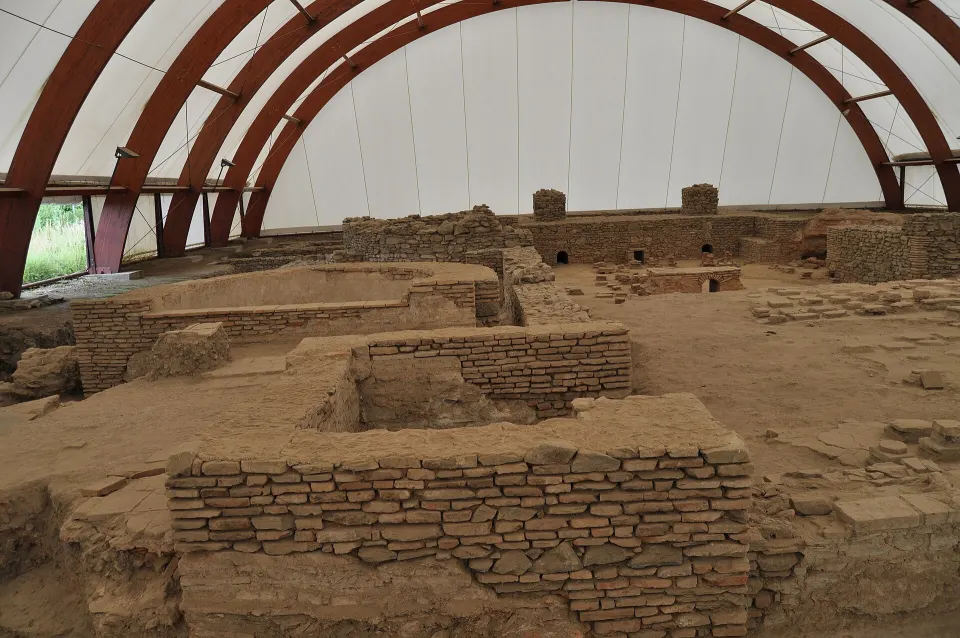
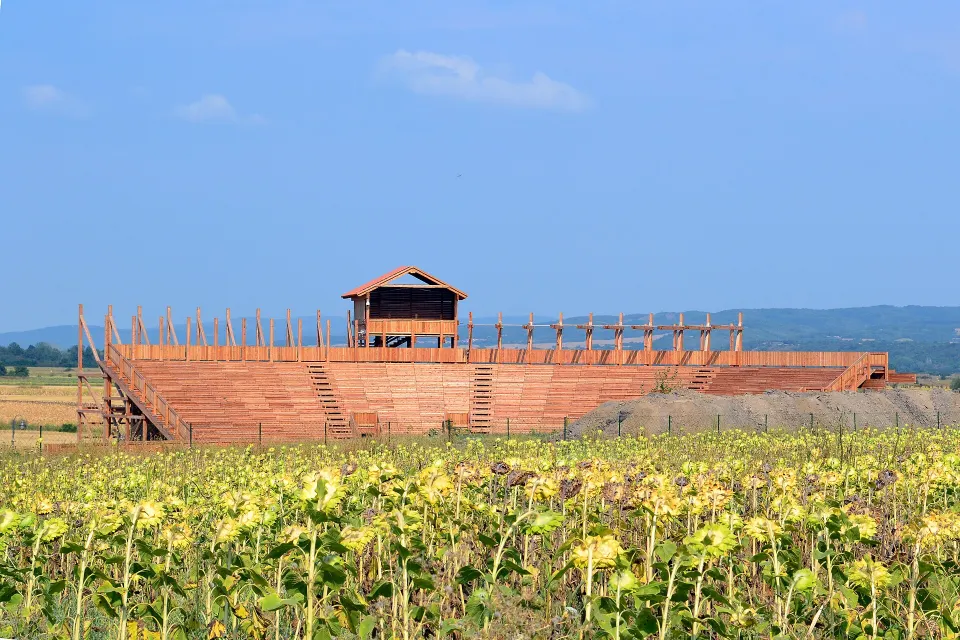
The Roman bath was in use from the 1st to the 4th century, and its hypocaust — the ancient underfloor heating system — survives to this day. Five apses have been recorded: four tepidaria with warm pools and one frigidarium with cold water, and the large number of oil lamps found here shows that the baths operated at night as well. The amphitheater, in the north-eastern corner of the city about fifty meters from the legionary camp, measures 84 by 74 meters with an arena of 55 by 45 meters and could hold around 7,000 spectators; the wall around the arena was painted with frescoes. The first, wooden amphitheater was erected in the early 2nd century, and the structure fell out of use in the late 3rd and early 4th century.
Domus Scientiarum and the Limes Park
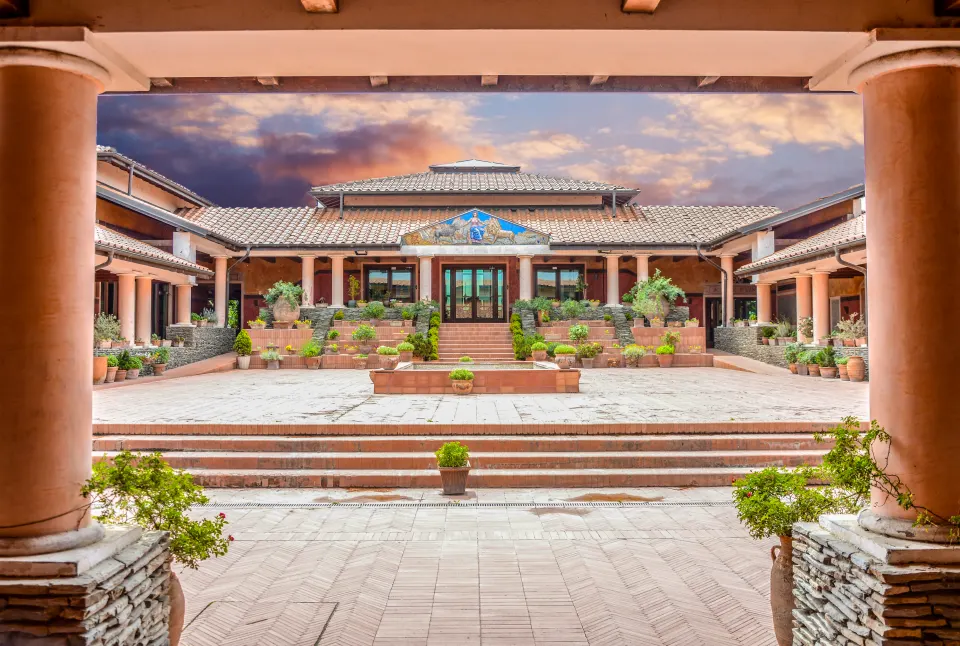
Domus Scientiarum is a research center built in the style of a Roman villa with a peristyle, housing laboratories and accommodation for researchers and visitors. Tourists visit the central peristyle; at the time of writing, the museum space inside the Domus is not part of the tour due to renovation works and the preparation of a new exhibition, so check the current situation on the park's official website (viminacium.org.rs) before you set off.
Vika the mammoth: the Romans' neighbor, a million years their senior
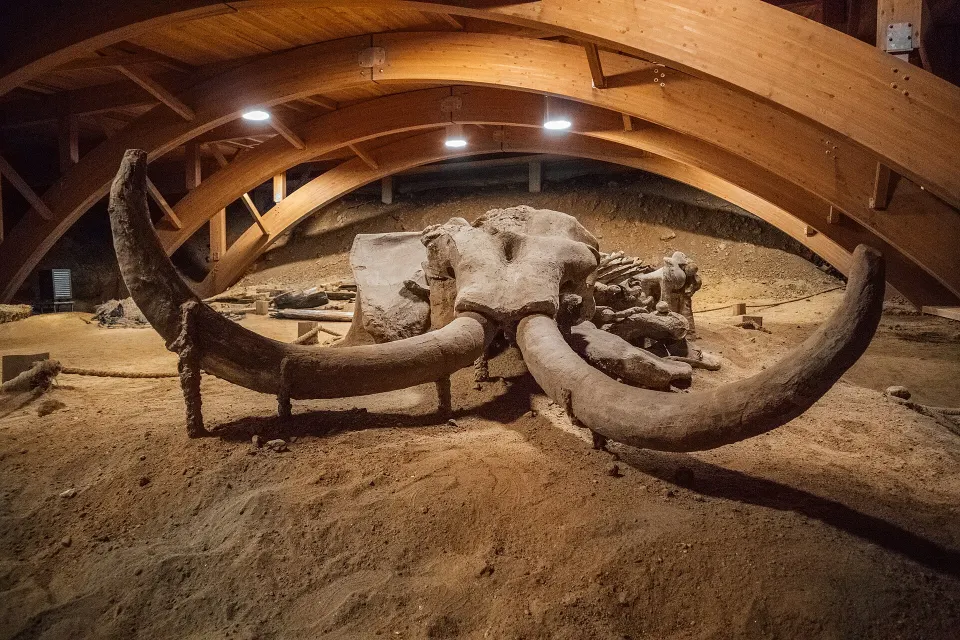
One of the most unusual discoveries at Viminacium has nothing to do with the Romans: in June 2009, at the Drmno open-pit coal mine, at a depth of 27 meters and just a few hundred meters from the imperial mausoleum, archaeologists unearthed the completely preserved skeleton of a female steppe mammoth (Mammuthus trogontherii), around a million years old. Vika was about 60 years old when she died, roughly 4.5 meters tall, more than five meters long and close to ten tons in weight, and she is unique in that she remained in anatomical position, at the very spot where she was found. The Mammoth Park officially opened in 2014, but — an important note — at the time of writing (July 2026) it is closed to visitors for reconstruction, as is the Adventure Park. If Vika is your main reason for visiting, be sure to check the status on the website or by phone at +381 62 232209 before you leave.
Viminacium ticket prices 2026 and opening hours
The prices in the table below are the official rates for individual visits, taken from the park's website in July 2026 — double-check them on the Tourism page of the official website (viminacium.org.rs) before you go, especially since outdated, much lower prices from previous years are still circulating online.
| Ticket | Adults | Pensioners | Primary school (10+) | Secondary school & university students |
|---|---|---|---|---|
| Archaeological site | 1,050 RSD | 850 RSD | 850 RSD | 950 RSD |
| Site + museum | 1,400 RSD | 1,100 RSD | 950 RSD | 1,200 RSD |
| Museum only | 600 RSD | 250 RSD | 100 RSD | 250 RSD |
Children under 10 accompanied by a parent enter free of charge (this does not apply to organized school trips), and the guide is included in the ticket price. Group visits and excursions must be booked in advance, by phone at +381 62 232209 or by email at [email protected].
Opening hours follow the seasons: from May to September the park is open 9 am–7 pm, in April and October 9 am–6 pm, in March and November 9 am–5 pm, and from December to February 9 am–4 pm. It is open every day except January 1 and 7. One key detail for planning: the last guided tour starts two hours before closing time — anyone arriving later can only join a group that has already set off. After heavy rain, some parts of the site, above all the amphitheater, may be temporarily closed.
How to get to Viminacium from Silver Lake
The distance from Silver Lake to Viminacium is about 40–45 kilometers, or a 45–60 minute drive, which makes this one of the most convenient half-day trips from Silver Lake. You have two routes to choose from:
- The faster route: from the lake to Veliko Gradište, then along national road 34 toward Požarevac, turning off toward Kostolac to reach Stari Kostolac and Drmno — the site sits next to the Kostolac B thermal power plant.
- The scenic route along the Danube: via Zatonje and Ram to Kličevac and Drmno. Ram Fortress is on the way, so you can combine a Roman city and an Ottoman fortress on the Danube in a single day. Bear in mind that the stretch of road beside the open-pit mine is in poorer condition and the signage is patchy in places.
There is no train to Viminacium and no direct bus line (the closest you can get by bus is Požarevac), so having your own transport is practically the only option. If you are coming straight from the capital, it is 95 kilometers from Belgrade via the E-75 motorway, taking the Požarevac exit. Parking is free at all parts of the site, and there is access for visitors with disabilities. Address for your navigation: Viminacium Archaeological Park, 12208 Stari Kostolac.
Practical tips for your visit
- Wear comfortable shoes — there is a fair amount of walking over open terrain with little shade, so in summer a hat and a bottle of water come in handy.
- Toilets are available only at the imperial mausoleum (including accessible ones for visitors with disabilities) — plan your break in time.
- The tavern serves hot and cold drinks all year round, plus ice cream from spring to autumn. The real treat is the Viminacium Roman feast — breakfast, lunch or dinner prepared from ancient Roman recipes — but it must be ordered and paid for at least five days in advance.
- Audio guides are currently unavailable; the souvenir shop stocks printed guidebooks and replicas of Roman artifacts.
- On weekdays in spring and autumn, school-trip season is in full swing — for a quieter visit, pick an early-morning slot or a date outside the excursion season.
- Please keep out of the private fields surrounding parts of the site — an official request from the park's hosts.
Tip: Even in mid-July, bring a hoodie or a light jacket — the underground frescoed tombs are noticeably colder than the outside, and for many visitors that part of the tour is the highlight. The contrast between the scorching heat above ground and the ancient chill beneath it is part of the experience.
Viminacium is rewarding for families too: the tour is short enough that children don't get bored, and the stories of gladiators and the legionaries of VII Claudia stick far better than any history lesson. You'll find more ideas for the little ones in our guide to Silver Lake with kids.
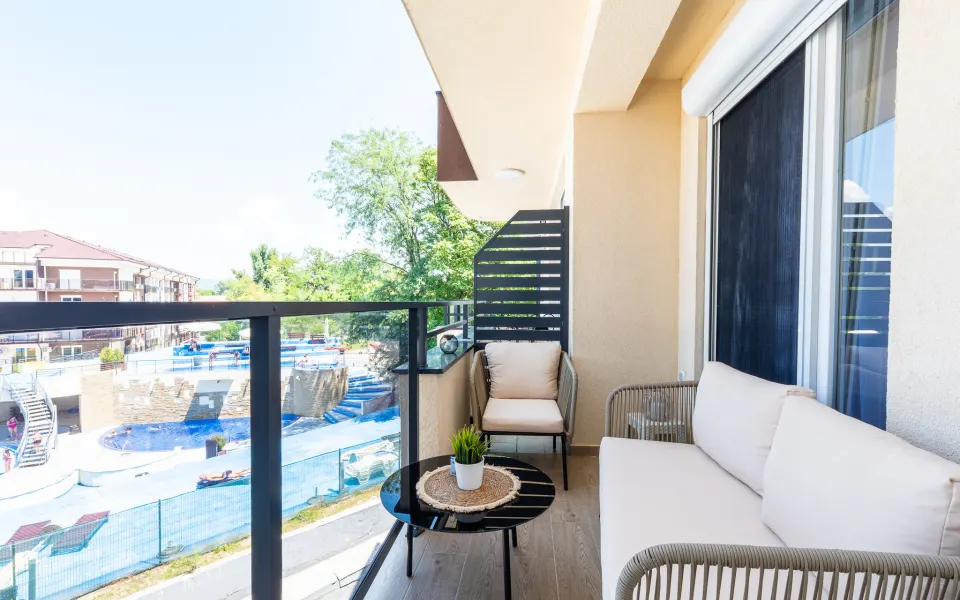
If you need a base for exploring this corner of Serbia, our apartment Silver Lake Residence sits directly above the Aqua Park at Silver Lake, 200 meters from the main beach — tour the Roman city in the morning and come back to a private terrace overlooking the pools. The roughly 40-square-meter apartment sleeps up to four guests, has a fully equipped kitchen, smart-lock self check-in with no waiting for the host, and a 5/5 rating on Google, from 50 euros per night. Check the availability calendar or find out more about the apartment on our homepage.
Viminacium is just one chapter in the ancient and prehistoric story of this stretch of the Danube: lovers of the distant past should also head to Lepenski Vir in the Đerdap (Iron Gates) gorge, and for the bigger picture of a holiday at the lake there is our comprehensive Silver Lake guide — where the Roman city on the Danube sits near the very top of the list of day trips, and with good reason.